Presumptive Legislation for Nurses
Let’s Advocate Together!
Please go to the Alberta Nurses for Change website for links to related articles and media and to get a copy of the petition for signing and distribution. If you have a UCP MLA, lobby your MLA to support a bill to include nurses (again) in presumptive legislation.
Presumptive legislation is a legal framework that presumes certain diseases or conditions are work-related without the need for the worker to prove the connection to their occupation.
Benefits
Protecting Nurses’ Health
Presumptive legislation would acknowledge that certain illnesses and conditions (like post-traumatic stress disorder) are directly related to their work and would allow easier access to workers’ compensation for these conditions.
Addressing Mental Health and PTSD
Nurses are at a higher risk of experiencing post-traumatic stress disorder (PTSD) and other mental health challenges. Presumptive legislation would recognize PTSD as an occupational hazard for nurses, ensuring they receive the support and benefits needed to address these issues.
Equity in Healthcare Workplaces
Ensure that healthcare workers are not unfairly burdened by proving that their work has caused their condition. This is particularly important for those in high-risk environments, where the connection between their work and health outcomes is clear, but proving that connection can be difficult.
Streamline WCB claims
Without presumptive legislation, nurses must prove that their illness or injury is directly linked to their job. This can be a long, difficult process, especially for conditions that develop gradually, such as long-term mental health issues like PTSD. Presumptive legislation simplifies this by assuming certain conditions are caused by work.
Supporting Work-Related Injury Prevention
Acknowledging the risks inherent in nursing encourages the implementation of stronger safety protocols, better training, and improved working conditions to reduce exposure to hazardous situations and prevent injury.
Historical Precedents
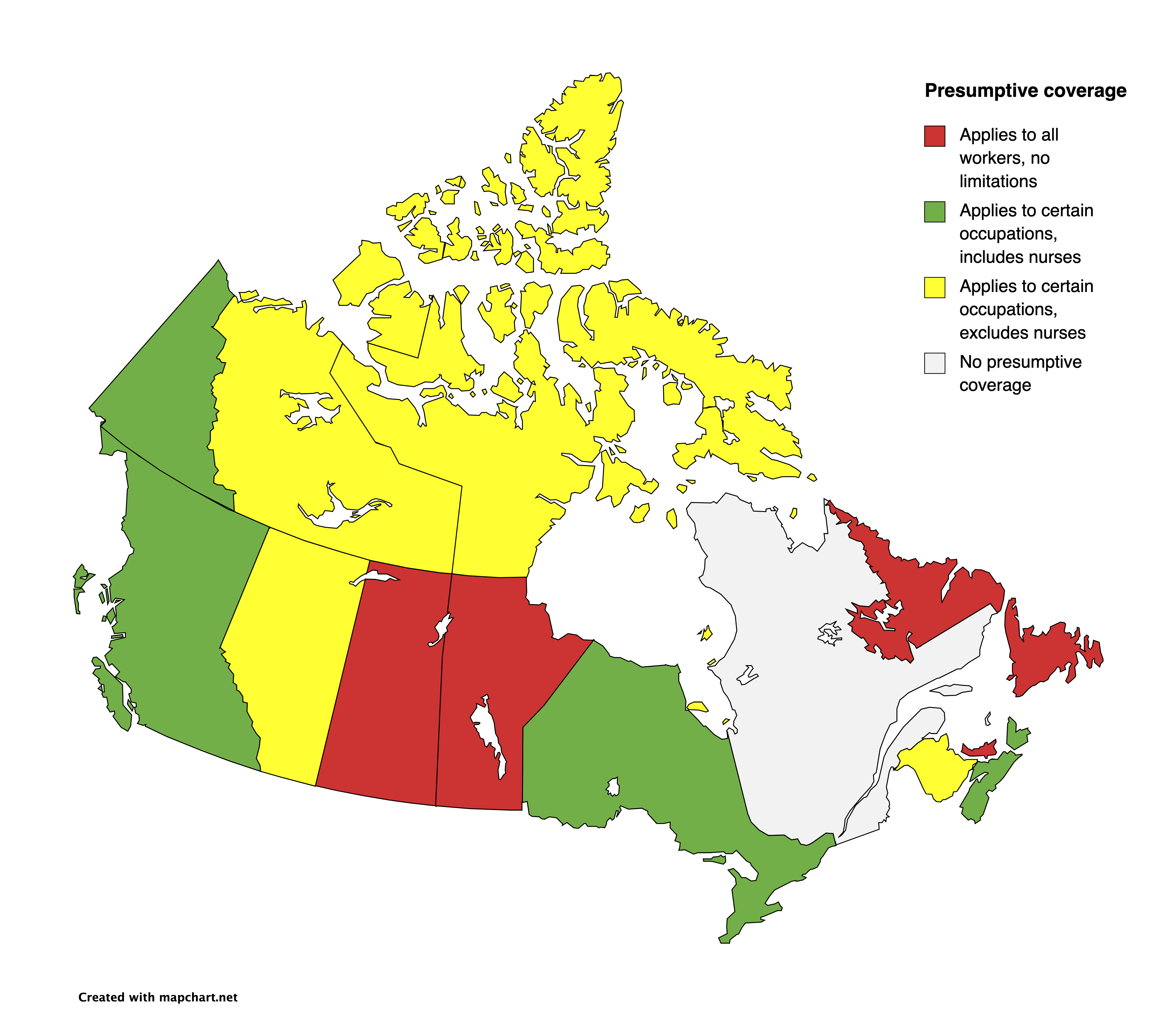
Other provinces in Canada, like Ontario and British Columbia, have already implemented presumptive legislation for nurses and other healthcare workers, recognizing their unique risks. Alberta’s adoption of such a framework would ensure that nurses receive protection and support comparable to their counterparts in different regions.
Bill 47
“Ensuring Safety and Cutting Red Tape Act”
— was a piece of legislation introduced in Alberta in 2020, primarily aimed at reforming the province’s Workers’ Compensation Act and several other worker protection policies.
One of the most controversial aspects of Bill 47 was the removal of nurses and other healthcare workers from the presumptive coverage for post-traumatic stress disorder (PTSD).
This decision represented a significant rollback in protections for healthcare workers, particularly nurses, who are regularly exposed to emotionally and psychologically taxing work environments, including dealing with life-threatening trauma, patient deaths, and the pressures of high-intensity healthcare settings. By removing nurses from the list of those with presumptive PTSD coverage, it was argued that the system would be fairer, more evidence-based, and would reduce unnecessary claims. The government required that the definition of PTSD should be more strictly defined, with a requirement for medical evidence that ties the condition directly to the workplace.
Before the introduction of Bill 47, Alberta had moved toward recognizing PTSD as an occupational disease for certain groups of workers. In 2018, the Alberta government passed Bill 27 (the Workers’ Compensation (Presumptive Coverage for PTSD) legislation), which made post-traumatic stress disorder (PTSD) a presumptive occupational disease for first responders like police officers, firefighters, and paramedics, as well as nurses and other healthcare professionals.
For more information, please contact Rachel Steel Local 196 A&E Committee Chair – rsteel@una.ca
 United Nurses of Alberta, Local 196
You must be logged in to post a comment.