
New Local 196 Podcast episode
Click HERE to listen to the newest podcast episode.
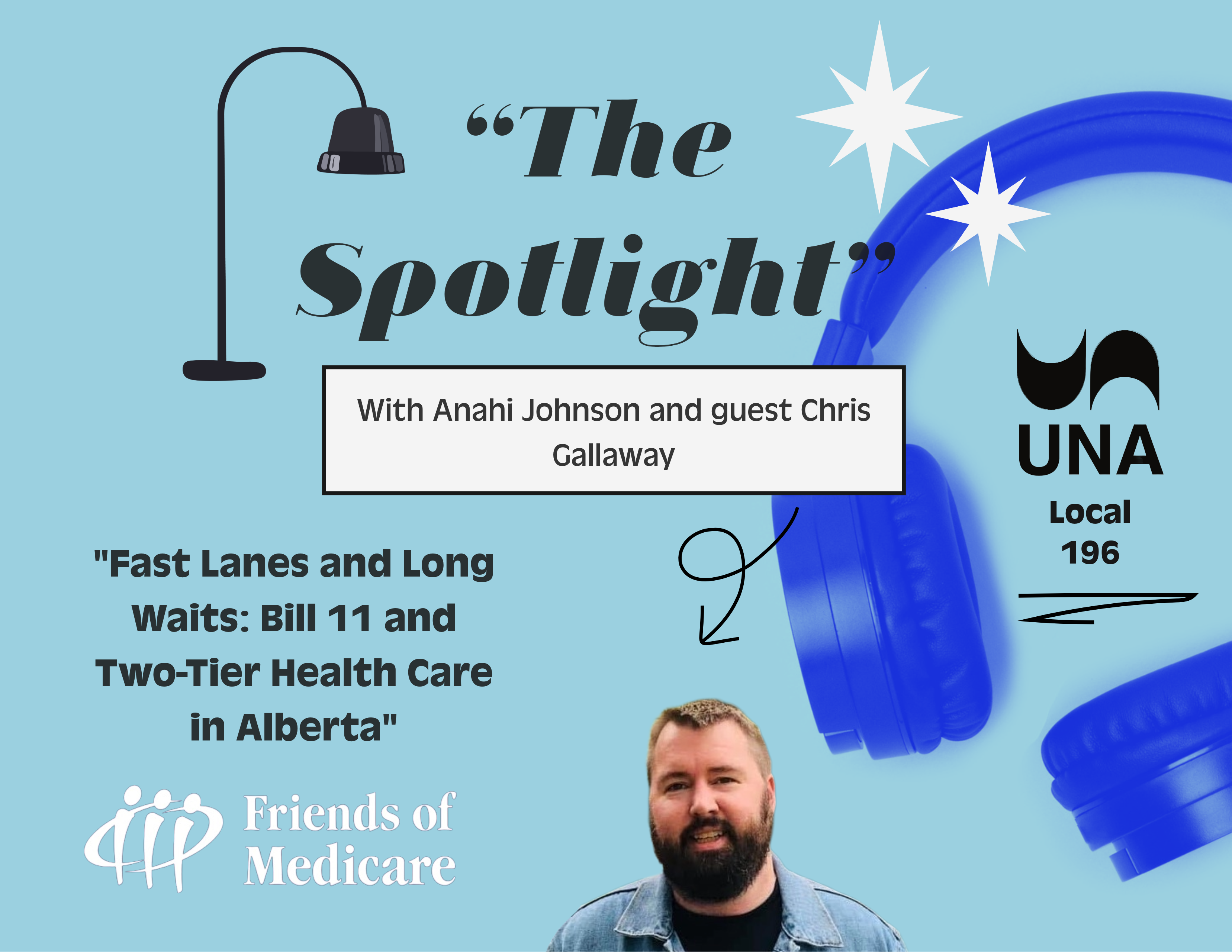
This episode focuses on Bill 11, the Health Statutes Amendment Act, and the growing debate around two-tier health care in Alberta. Critics warn that the legislation could open the door to expanded private payment for medical services, potentially allowing those who can afford it to access faster care while others face longer waits in the public system.
To help unpack what this could mean for patients, nurses, and communities, we’re joined by Chris Gallaway, Executive Director of Friends of Medicare, a national advocacy organization working to protect and strengthen Canada’s public health care system.
We’ll talk about what Bill 11 changes, why advocates across the country are raising concerns, and why Albertans are mobilizing for a Day of Action on March 16 in Edmonton to defend public health care.
Guest: Chris Gallaway
Chris Gallaway
Chris Gallaway is the Executive Director of Friends of Medicare, a national advocacy organization dedicated to protecting and strengthening Canada’s public health care system. Based in Edmonton, Gallaway has become a leading voice in Alberta on health care privatization, access to care, and the preservation of universal, publicly funded health services.
Guest Host: Anahi Johnson
Anahi Johnson
Anahi Johnson is a Registered Nurse and a dedicated union leader with the United Nurses of Alberta (UNA). As president of Local 32 (Glenrose Hospital), Anahi advocates for safe working conditions, strong public health care, and fair treatment for frontline health workers. Johnson has been actively involved in union work for many years, supporting colleagues through workplace advocacy, education, and collective action.
- Podcasts are available on Spotify, Apple Music and Amazon Music
New Local 196 Podcast episode

Click HERE to listen to the newest podcast episode.
This episode features a live recording from the February 19, 2026, Local Education Event, “Privatization in Healthcare and Education,” held at the ATA Building in Edmonton and organized by the Local 196 Education Committee. Moderated by Local 196 Secretary and Chair of the Communications and A&E Committees, Rachel Steel, the panel brought together research and advocacy perspectives to examine how privatization is reshaping Alberta’s healthcare and education systems. Participants wore red in solidarity with public education and wrote messages of encouragement to teachers, underscoring the community-centred spirit of the evening.
Panellists Rebecca Graff-McRae of the Parkland Institute and Heather Ganshorn of Support Our Students Alberta explored how funding pressures, corporatization, centralized decision-making, and “parental rights” narratives are influencing public policy. The conversation highlighted two possible futures for Alberta: one that strengthens universal, publicly delivered services rooted in equity and democratic accountability, and another that expands private influence within publicly funded systems. This episode invites listeners to reflect on what is at stake—and how collective action can shape the future of public healthcare and public education in our province.
- Podcasts are available on Spotify, Apple Music and Amazon Music
New Local 196 Podcast episode
By Gerri Logan
Click HERE to listen to the newest podcast episode.
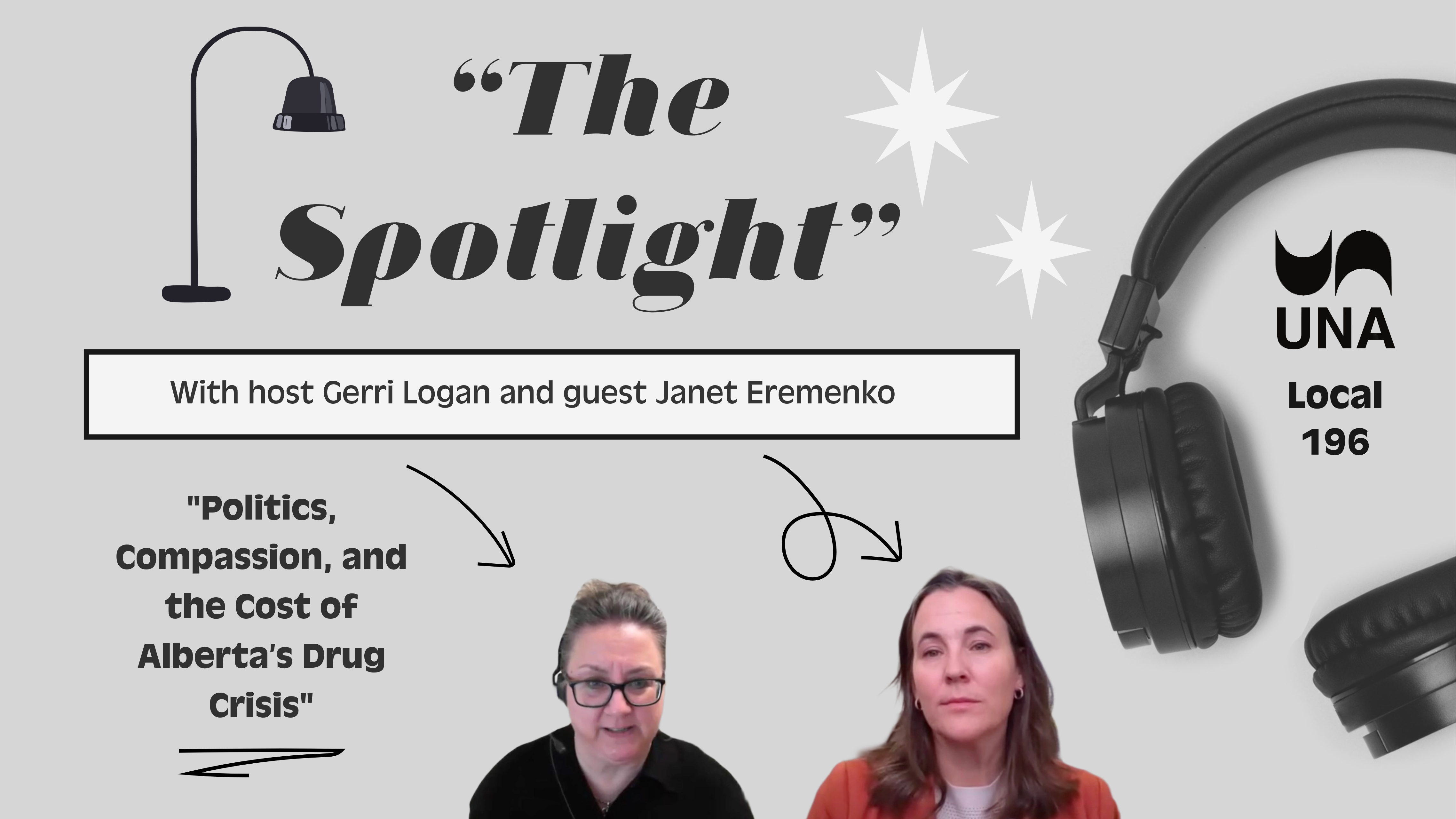
In this episode, Gerri Logan sits down with Janet Eremenko, Alberta’s NDP Shadow Minister for Mental Health and Addiction, to unpack the politics and human impact behind Alberta’s growing opioid crisis.
Janet Eremenko is a Canadian politician and member of the Alberta New Democratic Party. She serves as a Member of the Legislative Assembly (MLA) for Calgary-Currie. A lifelong Calgarian, Janet holds a degree in International Development and has more than a decade of experience in social policy and community development.
- Podcasts are available on Spotify, Apple Music and Amazon Music
New Local 196 Podcast episode
By Geri Ruston

Click HERE to listen to the newest podcast episode.
In this episode, Geri Ruston sits down with Dr. Bob Barnetson to examine the state of Occupational Health and Safety (OH&S) in Canadian workplaces, with a focus on Alberta and the realities faced by nurses.
Dr. Bob Barnetson is a Professor of Labour Relations at Athabasca University, whose academic and professional work centers on the political economy of workplace regulation in Alberta. His experience includes prior roles with the Alberta Labour Relations Board, Alberta Workers’ Compensation Board, and Alberta Employment and Immigration, giving him both policy and institutional insight into OH&S and workers’ rights.
The conversation covers:
- The true number of workplace injuries each year—likely double the official statistics—and why underreporting is so common.
- The role of the Workers’ Compensation Board (WCB) and why some employers may discourage workers from filing claims.
- The impact of Bill 47 and how it has reshaped workers’ rights to refuse unsafe work.
- The gender bias in how “dangerous work” is perceived, and why hazards faced by nurses and care workers are often minimized.
- Why increased reporting in unionized workplaces makes it appear that more injuries occur there, when in fact it reflects a culture of transparency and protection.
- Podcasts are available on Spotify, Apple Music and Amazon Music
Transfer of Nurses from AHS to Provincial Health Agencies
Assisted Living Alberta is a new provincial health agency in Alberta, officially launched on April 1, 2025, and is becoming fully operational by Fall 2025
United Nurses of Alberta has been informed that, effective September 1, 2025, close to 5,000 positions held by Registered Nurses represented by the union have been identified for transfer from Alberta Health Services to Acute Care Alberta (ACA), the three provincial health care corporations overseen by ACA, and Assisted Living Alberta (ALA). The process is expected to be the same as previous transfers (i.e. from AHS to Recovery Alberta and from AHS to Primary Care Alberta)
The government says these position transfers affecting UNA members will be broken down as follows:
- 56 to the Emergency Health Services (EHS) provincial health care corporation, under ACA
- 936 to the Cancer Care Alberta (CCA) provincial health care corporation, under ACA
- 3,969 to the Assisted Living Alberta provincial health care agency
Letter of Understanding:
RE: Transition of Employees Pursuant to the Health Statutes Amendment Act
The Health Statutes Amendment Act, 2024, enables the government to establish provincial health agencies and transfer employees from Alberta Health Services (AHS) to these new agencies. AHS and the United Nurses of Alberta (UNA) have agreed on a plan to support a smooth transition while protecting patient services.
The agreement will remain in effect until March 31, 2027, unless the parties agree otherwise in writing.
Employees whose positions are designated for transfer will receive official notification via their AHS email accounts. Formal transfer notices are expected to be sent to employees between July 21 and 24, 2025
Upon notification, employees have the following options:
-
Accept the Transfer: Employees who accept will transition, retain their current terms and conditions of employment, including pay, benefits, pension, seniority, and vacation entitlements.
-
Decline the Transfer: Employees who decline can exercise their rights under Article 15: Layoff and Recall to remain with AHS. Depending on available positions, this may involve displacement or reassignment within AHS.
Key points from the agreement:
- The Employer will notify all affected employees and provide them with the option to transfer or decline. Those who don’t respond by the 10-business-day deadline will be considered to have agreed to transfer.
- Employees on leave (e.g., medical, WCB) will be notified when they’re ready to return, and their transfers will be delayed until they return to work.
- Transferred employees won’t need to redo their probation periods.
- Employees already working in AHS and the new health agency can hold casual jobs with both.
More information can be found in the Collective Agreement Highlights in the:
May 2025 newsletter (review of the Letter of Understanding)
December 2024 newsletter (Article 14.07 and Article 15)
June 2024 newsletter (more on Article 15 – Layoff and Recall)
New Local 196 Podcast episode

Nurses’ Week Special Episode – The Fiery Mary “Mother” Jones
By Rachel Steel, Geri Ruston and Gerri Logan
Click HERE to listen to the newest podcast episode.
Rachel, Gerri, and Geri take listeners on an unforgettable journey through the life and legacy of Mary “Mother” Jones — the labour organizer once dubbed “the most dangerous woman in America.” From famine-stricken Ireland to the sweatshops and coalfields of the United States, the podcast traces how grief and injustice forged her into a tireless champion for worker safety and dignity.
But this isn’t just a history lesson. It’s a call to action. The episode draws parallels between the brutal conditions Jones fought against and the occupational hazards faced by Alberta nurses today, from violence and burnout to unsafe staffing ratios and systemic neglect.
The legacy of Mary Jones reminds us that the struggle for safe and just workplaces is far from over, and that every nurse who dares to speak out is walking in the footsteps of giants.
This episode was inspired by the OH&S article in the Spring 2025 UNA Bulletin, which highlighted Mary “Mother” Jones—many thanks to UNA OH&S Advisor Dewey Funk for bringing this figure to our attention.
- Podcasts are available on Spotify, Apple Music and Amazon Music
New Local 196 Podcast episode

Organizing for Change: Cori Longo on Activism and the Alberta Federation of Labour
By Rachel Steel
Click HERE to listen to the newest podcast episode.
In this episode of The Spotlight, we’re joined by Cori Longo, Secretary-Treasurer of the Alberta Federation of Labour (AFL), for an engaging and inspiring conversation about the power of activism and the importance of labour solidarity in Alberta. Cori takes us through her unique journey—from her first unionized job as a teenager to her time as a postal worker and registered nurse, and eventually into leadership roles within the Canadian Labour Congress and the AFL.
Drawing on over two decades of union experience, Cori shares how her frontline work shaped her commitment to workers’ rights and why political engagement is not just important but essential for protecting public services, workplace conditions, and the future of healthcare in Alberta. She presents a compelling argument for why nurses should view themselves as caregivers, advocates, and changemakers.
Throughout the episode, Cori explains the role of the AFL in supporting workers across all sectors and provides practical, empowering advice on how nurses and other workers can get involved, whether through policy advocacy, union participation, or grassroots organizing.
This episode is more than a conversation—it’s a rallying cry. Cori’s message is clear: when workers raise their voices, they can shift policy, protect their professions, and create lasting change. Whether you’re a seasoned union member or just starting to explore labour activism, this episode offers the insight and motivation to take that next step.
(The episode was recorded on March 14, 2025).
New Local 196 Podcast episode
Presumptive Legislation Round Table – The Fight for Presumptive Legislation with Guests Katrina Stephenson and Heather Murray
By Rachel Steel and Gerri Logan
Click HERE to listen to the newest podcast episode.
In this episode, hosts Rachel Steel and Gerri Logan explore the urgent need for presumptive legislation to protect nurses from psychological injuries such as PTSD and burnout. They are joined by Heather Murray and Katrina Stephenson, two passionate advocates fighting for policy changes recognizing mental health struggles as a workplace hazard for nurses.
The episode underscores the broader implications of inaction, warning that without proper mental health support, nurses will continue to leave the profession at alarming rates, worsening the ongoing healthcare crisis. The hosts and guests emphasize collective action, urging nurses to unite in advocating for policy changes that recognize and address these mental health challenges.
**Trigger warning** The discussion includes mention of suicide as it relates to job-related mental health injuries.
About the Guests:
Heather Murray
Heather Murray is a registered nurse with over 15 years of experience in emergency and critical care. A longtime advocate for nurse mental health, she has worked closely with professional associations and policymakers to push for presumptive PTSD legislation. Having personally experienced the emotional toll of frontline nursing, Heather is committed to ensuring that future generations of nurses receive better protection and access to mental health resources.
Katrina Stephenson
Katrina Stephenson is a nurse educator and mental health specialist who has spent the last decade supporting nurses dealing with trauma and burnout. She is a CAF Mental Health & Wellness Nurse and nurse Leader with Nurse 2 Nurse Peer Support. Katrina believes we need to approach each other with compassion and understanding around mental health and substance use challenges to reduce stigma and discrimination. She has been instrumental in bringing awareness to psychological injuries in nursing, speaking at conferences, and lobbying for legislative reforms.
 United Nurses of Alberta, Local 196
You must be logged in to post a comment.